Sidewalk comedy interviews depend on clean sound and quick reactions. Street corners present sirens, bus brakes, diesel engines, and crosswind. If your audio track distorts or picks up heavy traffic rumble, the comedy line fails in the edit. Viewers scroll past muddy audio within three seconds.
You can run this setup with two people: one on camera and one on the microphone. You can also run it solo if you lock off a wide lens on a tripod. Either way, gear choices and physical staging determine whether the interaction produces a usable clip or an unusable file.
Microphone types: dynamic capsules versus condenser capsules
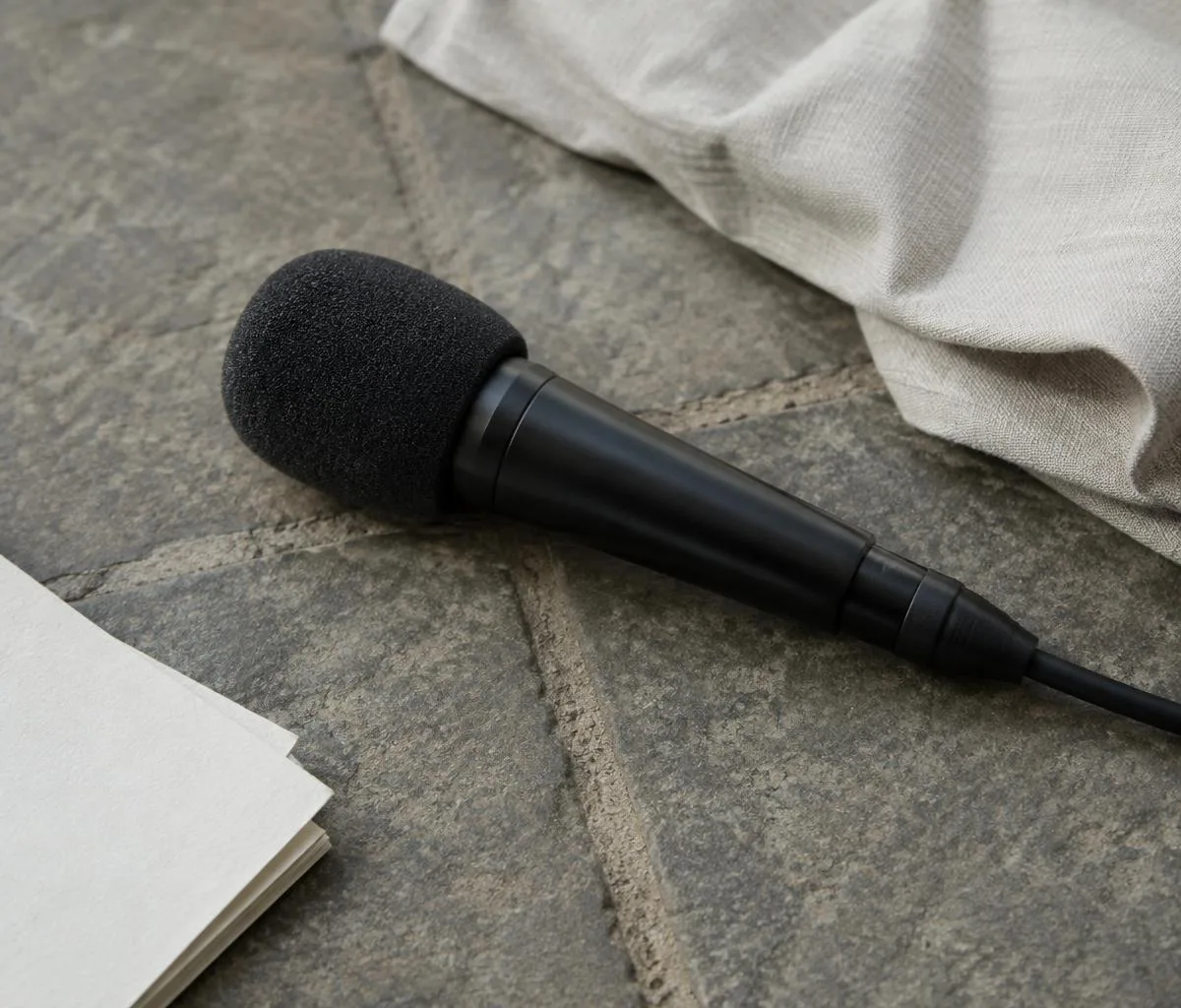
A dynamic microphone capsule uses a wire coil moving around a magnet to create an electrical signal. A condenser capsule uses a thin diaphragm placed next to a metal backplate, which requires electrical power from an internal battery or a 48-volt phantom feed from a recorder. Dynamic capsules tolerate drops, rough handling, and high sound pressure levels without overloading the preamp.
On a busy street, dynamic capsules perform better than condensers for comedy interviews. Condensers pick up transients, foot traffic, and background conversations fifty feet away. A dynamic microphone has lower sensitivity, which means it ignores background sound that falls outside its immediate pickup field. You want the microphone to capture only the speaker's mouth four inches away.
| Feature |
Dynamic Capsule |
Condenser Capsule |
| Power Requirement |
Passive (no external power) |
Requires +48V phantom power or battery |
| Sensitivity Level |
Low (approx -55 dBV/Pa) |
High (approx -38 dBV/Pa) |
| Off-Axis Traffic Noise |
Suppressed naturally |
Captured in detail |
| Durability |
Withstands physical impact |
Sensitive to drops and moisture |
| Polar Pattern Choices |
Cardioid or Omnidirectional |
Cardioid, Supercardioid, Multi-pattern |
Polar patterns change how you position the handle. Cardioid capsules reject sound coming directly from the back of the microphone. They work well when you point the rear of the mic directly at a wall of traffic. However, cardioid mics create a bass boost called proximity effect when held too close, and they create pops if a subject blows air across the basket. Omnidirectional dynamics, such as the Electro-Voice RE50B or the Rode Reporter, do not suffer from proximity effect. They pick up sound equally around the head, which forgives poor aiming when a subject moves their head unexpectedly during a joke.
Use a cardioid dynamic like the Shure SM58 or Sennheiser MD 46 if your location sits next to an active construction zone or a multi-lane roadway. Use an omnidirectional dynamic like the RE50B if you want a natural vocal tone and predictable gain levels across subjects of different heights.
Wind protection and handling noise elimination
Wind crossing a bare metal basket tears apart the low frequencies of a recording. The movement of your fingers across the barrel of the microphone also creates handling noise, which travels straight to the recorder as a mechanical thud. You must solve both problems mechanically before adjusting digital filters.
Standard open-cell foam covers stop gentle air currents from walking speeds. They fail when street gusts exceed eight miles per hour. For sidewalk comedy, fit a high-density acoustic foam core over the capsule first, then slide a synthetic fur cover over the foam. The fur hairs scatter the air currents before the wind reaches the core. This two-layer barrier prevents the capsule diaphragm from bottoming out.
- Internal rubber shock isolators: Mics engineered for broadcast, such as the RE50B, sit on internal rubber rings inside the metal casing. This stops finger friction from bleeding into the track.
- Handheld foam sleeves: If you use an entry-level dynamic mic, pull a cylindrical foam sleeve over the handle to cushion your grip.
- Cable routing: If using an XLR cable, wrap the cable once around your wrist and press the slack firmly against the base of the mic body. Loose cables slap the connector housing and generate audible clicks.
- High-pass filter engagement: Switch on an 80-Hz or 100-Hz low-cut filter on your audio recorder or transmitter. This filter removes low truck rumble without thinning human speech.
Never hold the microphone by the mesh grille. Wrapping your fingers around the capsule turns an omnidirectional microphone into a resonant, hollow-sounding cardioid mic and invites handling noise right next to the pick-up element. Hold the handle firmly in the middle third of the chassis.
The physical approach and distance boundaries
Pedestrians interpret a direct frontal approach as an obstruction or a threat. If you charge directly at someone walking down a sidewalk, their defensive reaction ruins the comedic exchange. You must establish comfortable spatial boundaries before you speak your first line.
Stand at a 45-degree angle to the pedestrian flow. Let the person walk into your peripheral vision, then turn your shoulders slightly toward them. Take one step back rather than one step forward. A step backward signals that you are not cornering them. Maintain four feet of personal space between your chest and their chest. This distance allows the camera to hold a clean two-shot without using an ultra-wide lens that distorts facial features.
Manage the microphone reach through precise mechanical actions:
- Keep your elbow bent at a 90-degree angle, pinned lightly against your rib cage.
- Rotate your forearm like a pendulum to pass the mic between your chin and the subject's chin.
- Keep the top of the capsule four to six inches below the subject's lower lip.
- Angle the capsule toward their nose at a 45-degree tilt to let vocal plosives like "P" and "B" pass over the top of the grille rather than into it.
- Do not let the subject grab the microphone. If their hand reaches out, draw your forearm back two inches and continue speaking.
Watch for physical signs of discomfort. If the pedestrian steps back, do not chase them with the mic. Chasing creates bad optics for both the interview and anyone watching down the block. Hold your ground, keep the mic at your own chest, and finish the line. If they stop, bring the mic back to their mouth distance.
Short question structures for punchy answers
Street interviews are not documentary sit-downs. Long, complex preambles cause pedestrians to lose focus or look into the camera lens. You need questions that demand rapid, involuntary processing so the subject speaks from their gut. Keep every opening question under eight words.
Construct prompts that force a concrete choice. Binary choices produce immediate arguments or distinct character traits. Open-ended inquiries produce rambling sentences loaded with filler words that require heavy cutting in post-production.
- Forced binaries: "Dogs or cats, and why are you wrong?"
- Absurd accusations: "What did you do with the briefcase?"
- Hyper-specific valuations: "How much cash to eat this dandelion?"
- Immediate superlatives: "What is the worst street name in this city?"
Deliver the question, bring the microphone instantly to the subject's mouth, and lock your lips shut. Novice interviewers ruin edits by laughing, saying "yeah," or agreeing while the subject is speaking. Any vocal noise you make while the microphone is near their face destroys the audio track. Keep your mouth closed and use your eyebrows or head nods to encourage them to keep talking.
If the subject pauses, count to four silently in your head. Do not fill the dead air. People feel an instinct to fill silence on camera. Their second answer, offered after three seconds of awkward silence, is almost always funnier and more honest than the initial canned response they gave to be polite.
Pedestrian consent protocols on public sidewalks
In the United States, individuals on public sidewalks possess a reduced expectation of privacy compared to private property. Anyone can photograph or film what occurs in plain view from a public space. However, commercial comedy production, monetization on social platforms, and brand sponsorships introduce legal considerations regarding right of publicity.
A verbal release recorded on camera is your primary tool in fast-moving street work. Once you finish an exchange that you intend to use in an edit, keep the camera rolling and the audio hot. Ask two brief questions to establish mutual understanding:
- State your name and confirm you are on a public street right now.
- Do we have your permission to air this interview on our comedy channels?
Get a distinct, audible "yes." A nod is hard to defend if a dispute arises later. If the subject says "no," mark the clip immediately as rejected, thank them, and delete the take during your evening media ingest. Airing an interview after someone clearly revoked consent invites formal takedown notices and disputes that drain production time.
Paper releases work best if you work with an assistant producer who stands eight feet behind the camera. While you scan for the next subject, the assistant approaches the previous pedestrian with a clipboard or a tablet release app. Offer a concrete incentive: a production sticker, a business card with the air date, or a five-dollar cash stipend. If your project has distributor backing or broadcast intentions, standard written releases become non-negotiable. Consult a qualified media attorney in your home state to draft your standard release forms, as public sidewalk recording rules differ across jurisdictions and foreign countries.
Sidewalk interview production is physically demanding. Small technical failures compound quickly over a four-hour shoot. Avoid these frequent operational errors:
- The chin dip: Lowering the microphone down to the subject's belly button because your arm gets tired. Keep the mic four to six inches from their mouth, even during long exchanges.
- Headphone neglect: Shooting without direct audio monitoring. Always wear at least one in-ear monitor or a closed-back headphone cup to catch wind overload, loose cables, or transmitter dropouts in real time.
- The walking chase: Attempting to walk backward while interviewing someone walking forward. This causes trip hazards, shaky footage, and uneven vocal volume. Stop your feet completely before delivering the question.
- Over-talking the punchline: Speaking your reaction line over the last word of the subject's answer. Leave a one-second pause before you react so the editor has clean cut points.
- Ignoring background visual context: Positioning the subject in front of a bright storefront sign that flickers, or directly under an awning that cuts out daylight and creates harsh shadows over their eyes.
Build your kit gradually rather than purchasing an entire field production package at once. Test your setup in low-stakes environments before approaching strangers on downtown avenues.
Begin by securing an industry-standard dynamic microphone with an integrated internal shock mount and a high-density foam cover. Connect it to a field recorder or a reliable wireless transmitter pack. Clip the receiver directly to your camera rig and set your audio gain manually so normal speech peaks between -18 dB and -12 dB. Never leave your input levels on auto-gain, which amplifies passing city buses every time you stop talking.
Take your rig to a public park. Practice passing the microphone smoothly between two friends without letting your hands scrape the barrel. Practice keeping the mic stable while walking. Run through twenty rapid-fire question concepts. When you can capture four clean minutes of dialogue without a single audio pop or handling thud, you are ready to take the setup to a busy city sidewalk.
This material provides general entertainment ideas only: consult local statutes and property owners before filming or using props in public spaces. Disclaimer