A visual gag is a mechanical assembly. It relies on physical objects, spatial relationships, and clear lines of sight. When a prop fails to produce laughter, the cause is rarely the concept. The failure happens in the workshop or on the floor. The prop is either too heavy to handle quickly, too small for the lens to resolve, or introduced at the wrong angle relative to the key light. Physical comedy requires the same precision as tool calibration. You measure the clearance, calculate the weight, and fix the trajectory.
Prop scale and movement work together to direct the eye of the viewer. If an actor swings a regular hammer, the brain registers maintenance work. If the hammer head measures 18 inches across and weighs four ounces, the brain registers an anomaly. That visual shift changes how the audience processes the next motion. This guide breaks down the physical dimensions, balance points, timing windows, and lens positions required to make prop-driven comedy function on stage and on camera.
The rule of three in prop manipulation
The rule of three is an operational pattern. It establishes an expectation, reinforces the expectation, and then breaks it. In prop work, the pattern relies on identical physical weight and handling during the first two cycles, followed by an abrupt shift in material resistance or dimension on the third cycle. If the handling changes during the second cycle, the sequence collapses because the pattern never settled into the viewer's working memory.
Consider the process of opening a series of three crates with a crowbar. For the first two crates, the actor exerts identical force. The crowbar flexes against the pine lid, the wood splinters with an audible crack, and the lid breaks free. The actor spends four seconds of muscular effort on each. For the third crate, the prop department substitutes a lid made of thin craft foam painted with faux wood grain. The actor applies the same four-second force vector, but meets zero resistance. The crowbar blows through the foam, driving the actor forward onto the floor.
| Repetition |
Mechanical Role |
Prop Material |
Actor Muscle Engagement |
| First Action |
Baseline establish |
Solid pine, 0.75-inch thickness |
Full isometric tension |
| Second Action |
Baseline confirmation |
Solid pine, 0.75-inch thickness |
Full isometric tension |
| Third Action |
Structural rupture |
EVA foam, 0.25-inch thickness |
Zero resistance release |
The rhythm between these actions must remain mechanical. The time spent between action one and action two creates the baseline cadence. If the actor takes six seconds to reset between the first and second crate, the reset between the second and third crate must also take six seconds. Variations in the reset period confuse the audience. They begin to watch the actor's hesitation instead of tracking the prop.
Contrast ratios: tiny objects for massive chores
Visual disparity creates immediate comprehension. When an actor uses an undersized tool for an industrial task, the humor comes from the obvious gap between the required kinetic energy and the available surface area. The human brain calculates structural load automatically. Presenting a tool that violates those calculations forces an immediate reassessment of the scene.
To fell a log with a 14-inch diameter, a woodsman uses a felling axe with a 36-inch hickory handle and a four-pound steel head. In a visual gag, replace that tool with a brass jeweler's hammer measuring five inches in total length with a 0.5-ounce head. The actor does not tap the log casually. They take a wide athletic stance, chalk their palms, swing with full shoulder engagement, and strike the bark. The tool makes a light ping. The log does not move.
Scale inversion also operates in reverse. An actor needs to sign a standard paper receipt. Instead of a ballpoint pen, they pull a four-foot carpenter's lumber crayon from a breast pocket. The joke relies on three measurable criteria:
- Plausible origin: The prop emerges from a location that normally holds the standard version, requiring tailor-made hidden drop pockets or false lining inside a coat.
- Correct grip: The actor holds the oversized prop using the standard fine-motor tripod pinch rather than a whole-hand club grip, treating the giant tool as an ordinary pen.
- Functional consequence: The tip must actually mark the surface, crushing the desk or ripping the paper under the weight of the motion.
Keep the surrounding environment rigid and realistic. If the desk, the room, and the background actors are all stylized or cartoonish, the scale contrast disappears. The oversized or undersized prop must exist in an unyielding, everyday world to make the scale ratio readable.
The timing pause before the physical reaction
A physical impact requires an evaluation period. If an actor gets struck in the face with a foam brick and falls down on the exact frame of impact, the movement looks like a stunt, not a comedy beat. Laughter requires an analytical gap between the stimulus and the physical collapse. We call this the processing delay.
The human eye tracks action at roughly 24 frames per second. An impact takes one to two frames. The processing delay should last between 14 frames and 22 frames, roughly half a second to three-quarters of a second. During this window, the actor does not move their limbs. They hold absolute stillness. The gaze remains fixed on the point where the impact originated. This stillness communicates that the brain is attempting to integrate the disaster before the nervous system surrenders.
Execute the sequence using this mechanical breakdown:
- Delivery: The prop travels along a clean line into the target zone at terminal velocity.
- Impact: The prop strikes the surface, compresses, and bounces clear. The recipient absorbs the shock without shifting their stance.
- The freeze: The recipient holds the exact posture for 18 frames. The eyes do not blink. The jaw does not slacken yet.
- Micro-tell: A small secondary object moves. A hat tilts forward, a pencil falls from behind an ear, or a single drop of water drips from the nose.
- Collapse: The recipient drops straight down along the vertical axis, knees folding first, rather than pitching backward like an action movie stunt.
If the actor blinks or resets their balance during the freeze, the rhythm breaks. The gag reads as an accident or bad stunt coordination. Train performers using a metronome set to 60 beats per minute. One beat for impact, one beat for the freeze, one beat for the release. Once that three-count is reliable, shorten the freeze by quarter-second increments until the action looks sharp.
Camera framing for legible physical action
A visual gag requires deep depth of field and stable frame borders. Contemporary cinematic habits, such as shallow focus, loose handheld operating, and rapid close-up cutting, destroy visual comedy. If the camera searches for focus while a prop is falling, the gag fails because the audience misses the launch point. If the frame cuts during the swing, the spatial logic dissolves.
Physical comedy demands a medium-wide or full shot. The viewer must see the actor's feet, the tool in their hands, the target surface, and the sky or ceiling above them. The viewer calculates the trajectory of an object through continuous space. A single cut during the flight of an airborne prop instantly creates the suspicion of a digital effect or an off-camera stagehand toss, which robs the action of its physical punch.
| Shot Type |
Focal Length (Full Frame) |
Aperture Setting |
Primary Comedy Function |
| Wide Proscenium |
28mm to 35mm |
f/8 to f/11 |
Full-body falls, ladders, structural wall collapses |
| Medium American |
40mm to 50mm |
f/5.6 to f/8 |
Hand tools, food interactions, coat-pocket reveals |
| Tight Reaction |
85mm |
f/4 to f/5.6 |
Micro-tells, eye shifts, single drops of liquid |
Lock the camera head. A locked tripod allows the viewer to use the edges of the monitor as a fixed ruler to judge speed and displacement. If an actor slips on an oil patch and the camera tilts down to chase them, the actor appears to stay in the center of the frame while the room shifts around them. When the camera remains locked, the actor drops completely out of the frame, leaving an empty room. The emptiness of the frame is often the element that finishes the joke.
Common camera angle mistakes that hide punchlines
The most frequent error in shooting physical comedy is placing the camera on the wrong side of the action axis. If an actor pulls an enormous wrench from their left hip pocket, but the camera is positioned at a 45-degree angle off their right shoulder, the actor's own torso obscures the scale of the tool during the draw. The reveal is ruined because the prop is hidden behind chest tissue and elbow joints until it is already fully extended.
Another routine mistake is zooming or pushing in during the build-up. Camera movement introduces an artificial visual rhythm that competes with the actor's timing. If the camera dolly creeps forward while an actor balances an eight-foot stack of china plates, the relative movement of the background makes it impossible for the audience to tell whether the plates are leaning at three degrees or six degrees. You rob the audience of the ability to judge the physics for themselves.
A third error is shooting visual gags with long telephoto lenses from a distance. Telephoto lenses compress space along the Z-axis. A rake lying on the ground five feet in front of an actor looks like it is resting directly against their boots when viewed through a 135mm lens. When the actor steps forward and hits the tine, the handle flips up instantly without any visible travel time. Use wider lenses positioned closer to the subject to preserve depth, so the viewer can track the distance between the foot and the hazard.
Working with comedy props involves recurring mechanical traps that waste production time. Avoid these setup errors:
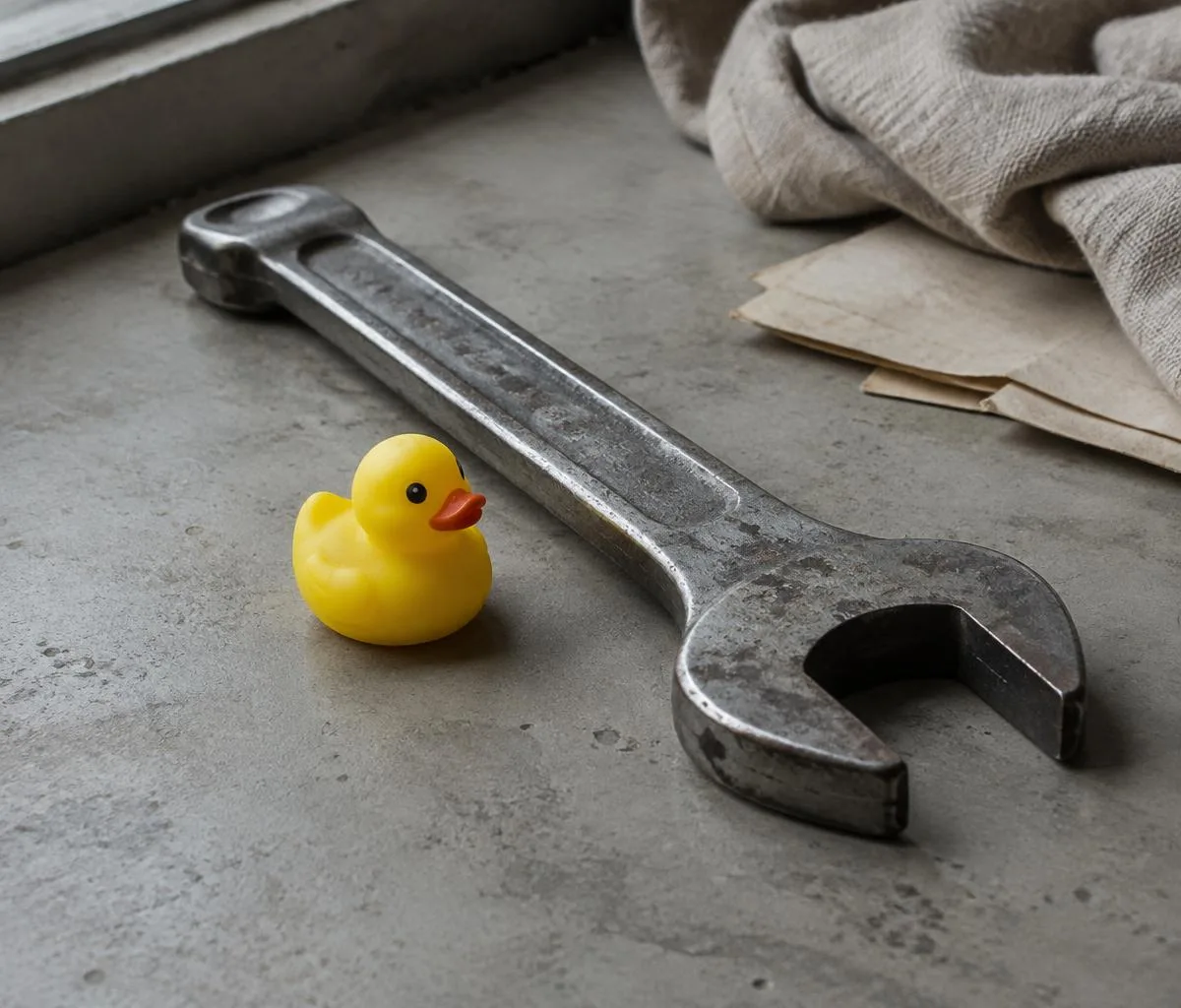
- Over-weighting soft props: Making a fake wrench out of solid urethane rubber instead of low-density foam. The heavy rubber flexes unnaturally when swung, ruining the illusion of rigid steel before it ever hits the target.
- Under-lighting the prop color: Painting a prop the same value as the background set. If an actor holds a matte black crowbar against a dark walnut bookshelf, the silhouette disappears entirely. Use a minimum of a three-step brightness separation between the prop and the set behind it.
- Acting the weight instead of building the weight: Asking an actor to pretend an empty cardboard box weighs 80 pounds. Performers almost always overact this by shaking their hands and grimacing. Glue 40 pounds of lead shot into the base of the box instead. The actor's tendons will tighten naturally without pantomime.
- Ignoring rigging safety: Suspending heavy set pieces with unrated hardware. A breakaway chandelier or dropping beam must be rigged with load-rated aircraft cable, release pins, and secondary safety lines installed by a certified rigger. Never compromise on structural rigging to save ten minutes on set.
Practical workshop drills for tomorrow
Do not wait for a full rehearsal to test prop visibility and timing. Use these direct workshop steps to check your equipment:
First, run a contrast silhouette test. Place the prop on a work table in front of a flat grey board. Set your camera to black-and-white mode and step down the exposure by two stops. If you cannot identify the clear outline of the object in less than one second of viewing, alter the prop's paint scheme. Add edge highlights, increase the sheen, or change the handle tone until the silhouette cuts through clearly in monochrome.
Second, calibrate your scale ratios with a balance test. If you are building an oversized tool, aim for a scale factor between 2.5:1 and 3.5:1 compared to the standard object. Anything under 2:1 looks like a manufacturing variation or an industrial tool rather than a comedy prop. Anything over 4:1 becomes unwieldy, bending under its own weight and forcing the actor into a clumsy carrying posture that hides the silhouette.
Third, rehearse the three-beat cadence with a digital timer. Record five takes of a simple prop interaction: picking up a tool, using it, and setting it down. Review the footage frame by frame. Check whether the actor's reset movements between repetitions match within a three-frame window. If the timing drifts, adjust the prop's physical balance points by moving internal counterweights until the tool moves cleanly along the same path every time.
This material provides general entertainment ideas only: consult local statutes and property owners before filming or using props in public spaces. Disclaimer